
Review · KIMONO & TEA CEREMONY
Kyoto: Tea Ceremony with Maiko Premium
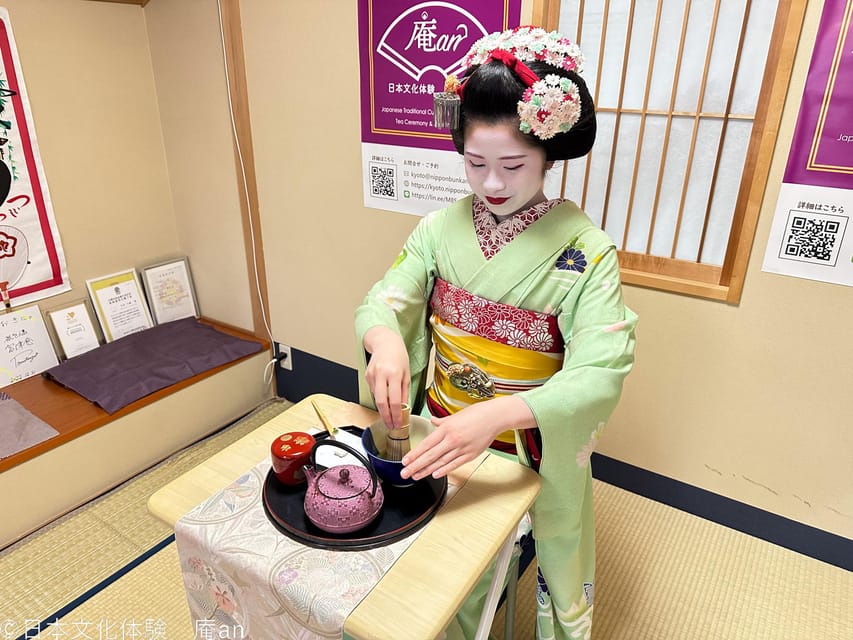
The most memorable part of this Kyoto experience is the chance to speak directly with a Maiko, not simply watch one from across a stage. She explains her daily life, demonstrates matcha preparation, answers questions, performs two dances, and joins a playful traditional game.
I like the mix of clear cultural explanation and real interaction, and I like that the $50 Premium price includes the dance and game rather than stopping at a short tea demonstration. The main drawback is the setting: this is a plain room in a modern building, not an atmospheric tatami tea house.
What makes this experience worth considering
- Meet a Maiko up close: Ask about her training, clothing, hairstyle, work, and daily routine during a dedicated question period.
- Make your own matcha: The Maiko demonstrates the process, then you prepare your tea with two dried Japanese sweets.
- Watch two traditional dances: Each performance reflects Japanese seasons, stories, or everyday life.
- Join a traditional game: Volunteers can play with the Maiko, while everyone else claps and watches.
- Take a commemorative photo: You can pose beside the Maiko and receive a Senjafuda lucky charm.
- Reach it easily: The venue is a one-minute walk from Exit 1 of Gojo Station, though you must climb stairs because there is no elevator.
Meeting a Maiko without entering an ochaya
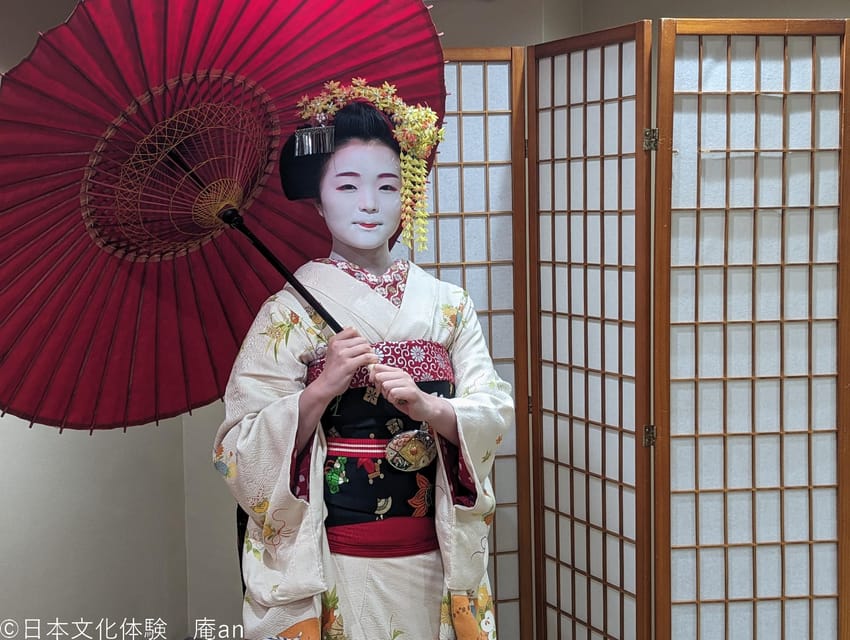
Kyoto’s Maiko are young women training in the traditional entertainment arts associated with the city’s geiko districts. Their elaborate kimono, painted makeup, hairstyling, music, dance, and formal manners are not a costume show created for this program. They represent a living profession that still exists in Kyoto.
That context matters. You are not just taking a photo with someone dressed in old-style clothing. The Maiko speaks about the work and discipline behind the appearance, including her training and daily routine. One recent session included a discussion of the roughly five years needed to complete the path toward becoming a Geiko.
This is not an ochaya, the private entertainment house traditionally associated with geiko and Maiko culture. It is also not held in a traditional Japanese home. The room is in a building near Gojo Station, with tables, chairs or stools, and a functional presentation area. Some of the backdrop includes company advertising, which can show up in your photographs.
I would set your expectations clearly before booking. If you want the atmosphere of a private Kyoto tea house, this is not that. If you want a manageable way to meet a Maiko, ask questions, see a performance, and learn a little about the culture, the modern setting is a fair trade.
More Kimono and Tea Ceremonies in Kyoto
- Kimono Tea Ceremony at Kyoto Maikoya, NISHIKI
★ 5.0 · 911 reviews - Kyoto: Kimono Tea Ceremony at Orizuruya Gion
★ 4.9 · 618 reviews - KYOTO Tea Ceremony with kimono near by Imamiya Jinjya Shrine
★ 5.0 · 343 reviews
The 90-minute program, step by step
The schedule begins with a greeting from the Maiko. She enters in full formal dress, and the host helps frame the session. The instructor language is Japanese, with English translation provided as much as possible when requested.
The exact flow can feel more like a cultural presentation than a formal tea ceremony. That is important because the word tea ceremony can suggest a long, quiet ritual in a tatami room. Here, the tea portion is hands-on and friendly. You learn the basic movements, then prepare your own matcha.
Preparing matcha with two Japanese sweets
The tea segment is the most interactive part at the beginning. The Maiko shows you how to make matcha and explains what to do before you try it yourself.
You receive matcha and two dried Japanese sweets. The sweets give you something small to taste alongside the tea and help explain the relationship between Japanese hospitality, sweets, and powdered green tea.
Do not expect an advanced tea-school lesson. This is a basic introduction designed for first-time visitors, families, and anyone who wants to participate without special preparation. The tea may taste quite strong if you are unfamiliar with matcha, but the process is simple enough for children to follow with help.
The listed package includes snacks and a drink. Other drinks may also be available inside for an additional charge, so do not assume every beverage is included.
The question and answer session
For me, this is the part that gives the program its purpose. The performance is beautiful, but the questions help you understand the person behind the makeup and kimono.
You can ask about the Maiko’s daily life, training, traditions, and work. The sessions have included friendly Maiko who were happy to answer questions, and one host named Karen was especially helpful in guiding the discussion. Another recent program had a tea instructor who spoke both Japanese and English, which helped a mixed-language group.
English support is not guaranteed at the same level in every session. The official language is Japanese, and translation is provided as much as possible if you request it. If detailed English explanation matters to you, contact the provider before booking rather than assuming every Maiko will speak English.
The group format also affects the question period. You are not sitting alone with the Maiko. Several people may want to ask something, and noisy participants can make the room less calm. Still, the program allows enough time for questions, and the format feels more personal than a stage performance with no conversation afterward.
More Tea Ceremonies in Kyoto
- Kyoto: Tea Ceremony in a Traditional Tea House in Kiyomizu
★ 4.9 · 3,519 reviews - Kyoto: Tea Ceremony Ju-An at Jotokuji Temple
★ 4.9 · 3,207 reviews - Kyoto: 45-Minute Tea Ceremony Lesson Experience
★ 4.3 · 2,378 reviews - Kyoto: Table-Style Tea Ceremony at a Kyo-Machiya
★ 4.9 · 1,211 reviews
Photos beside the Maiko
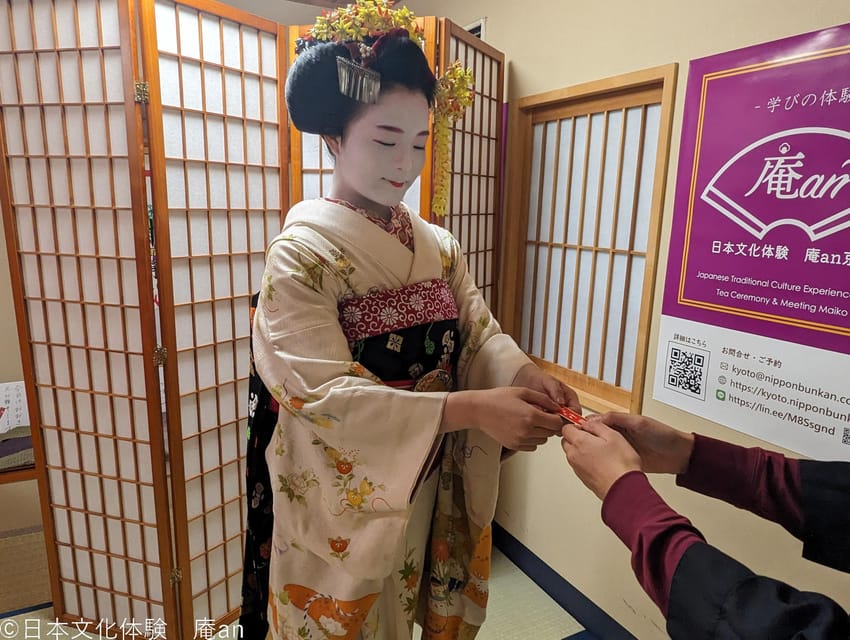
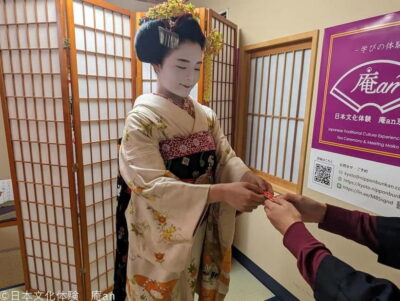
The photo opportunity comes after the question period. You can take a commemorative picture beside the Maiko, and she presents a Senjafuda, a small lucky charm associated with her name or presence.
Bring your phone or camera, but keep your expectations realistic about the background. The company’s signage and QR code may appear behind the performance and photo area. You can still get a meaningful picture, but this is not the polished backdrop of a historic tea room.
You should also follow the host’s instructions about when photography is allowed. The program specifically offers photos with the Maiko, and some people have taken photos and videos during the presentation, but a respectful approach is best. Keep the activity moving and avoid blocking the view for others.
Two dances that show a different side of Maiko culture
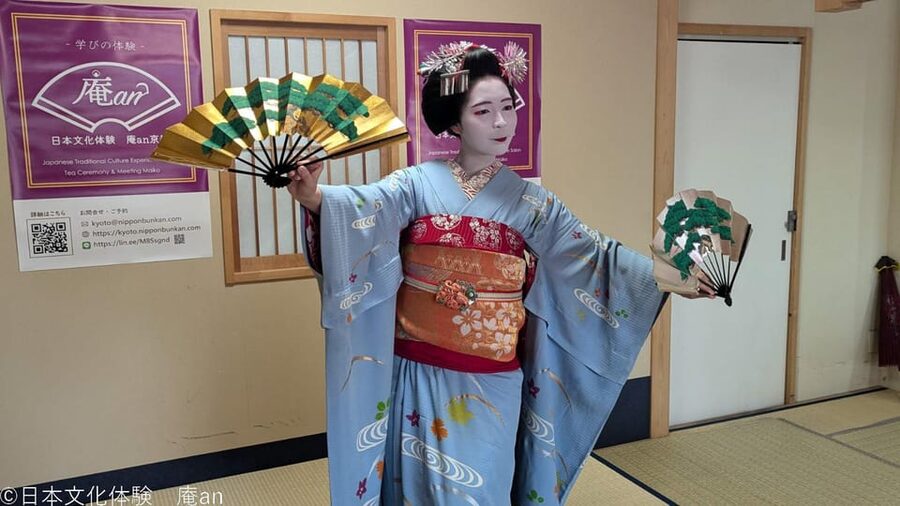
The Maiko performs two traditional dances. These pieces can express the seasons, love stories, or everyday life, and their appeal comes from small movements rather than large stage effects.
Pay attention to the hands, posture, eyes, and controlled steps. The elegance can be easy to miss if you focus only on the kimono. The dance is the quietest section of the program, and it gives you a chance to see the training behind the Maiko’s presentation.
This is the portion most likely to feel special even if you know little about Kyoto’s traditional arts. The room may be plain, but the performance itself provides the atmosphere. Some sessions have included a Geiko instead of a Maiko, depending on availability. That is not a lesser version of the program. It is simply a different performer from the same traditional world.
The game keeps the room from feeling stiff
After the formal dance, the mood changes. The Maiko joins an interactive game, and volunteers can play while everyone else watches, claps, and cheers.
This is a smart part of the Premium program because it shows the social side of Maiko hospitality. You are not expected to sit perfectly still for 90 minutes. The game is simple, lively, and suitable for families, although the Maiko has plenty of practice and may be harder to beat than expected.
Children have especially good reason to enjoy this section. Families with children aged four and ten have found the mix of tea, questions, dancing, and play easy to follow. Children under two can attend free when sitting on a parent’s lap, but a separate seat or meal is charged at the regular one-person rate.
The game also means the program is not purely solemn. If you want a quiet, formal tea ceremony, this may feel too casual. If you want your children or less museum-minded companions to stay interested, the game is a strong reason to choose the Premium option.
Is the $50 Premium price good value?
At $50 per person, the program is priced as a compact cultural activity rather than a full evening of traditional entertainment. I consider it good value if you want several elements in one sitting: matcha preparation, sweets, a question period, two dances, a game, a photo, and a small gift.
The most important comparison is with the less expensive version of the activity. The Premium package is the one to choose if you want the dances and game included. Several people who enjoyed the program specifically recommended choosing Premium because it provides the fuller experience.
There are also seating supplements:
- SS first row: 3,300 yen
- S2 second row: 2,200 yen
- S3 third row: 1,100 yen
Those charges are separate from the listed price. A closer seat may help with photographs and viewing the dance, but I would not assume it transforms the basic room into a traditional setting. The atmosphere comes from the Maiko, not the furniture.
For a family, the value is stronger because the program offers several different kinds of activity in 90 minutes. For someone interested only in matcha, the package may be more than needed. For someone interested only in professional dance, a dedicated performance may provide a more polished stage.
The practical details that affect your visit
The venue is a one-minute walk from Exit 1 of Gojo Station on the Karasuma subway line. The entrance faces Gojo-dori, the main street, so it should be straightforward to locate. I would arrive about 15 minutes early. One useful tip is that early arrival may let you see the Maiko arrive by taxi, though that is an incidental moment, not a promised part of the program.
The building has no elevator. You need to use stairs to reach the venue, so this is an important consideration for anyone who cannot manage stairs comfortably.
The scheduled program lasts 90 minutes. The main sequence runs from the opening greeting through the tea, questions, photo, Senjafuda presentation, dance, and game. Around the 75-minute point, the Maiko leaves, followed by a short chatting period before room departure at about 90 minutes.
Allow the full time in your plans. A session can feel shorter if transitions move quickly, and one account put the active portion closer to 70 minutes. Do not schedule a train, meal, or ticketed sight immediately afterward.
The operation runs from 10:00 to 17:00, and reservations received after 17:00 are processed the next day. Late arrivals are not accommodated, regardless of the reason, so build in time for finding the entrance and climbing the stairs.
Cancellation is free up to eight days before the activity for a full refund. After the cancellation fee applies, changing the date or time can also bring a specified fee. The provider does not cover your travel costs if you cancel or miss the session.
Who will enjoy this Kyoto activity most?
I would recommend it to a first-time visitor who wants a direct introduction to Maiko culture without committing to an expensive private dinner. It also suits families, couples, and curious adults who prefer conversation and participation over simply watching a performance.
It is particularly useful when your Kyoto schedule is tight. The activity takes 90 minutes, sits close to a subway station, and combines several experiences that would otherwise require separate planning.
You should think twice if the room itself is central to your idea of a Japanese tea ceremony. The setting is functional rather than historic, and the branded background can weaken the photographs. You should also be comfortable with a group format, stairs, and some translation rather than a fully English-language presentation.
The program is best approached as a cultural meeting in a modern venue. The Maiko’s explanations, dance, and personal presence provide the substance. The room simply provides a place to gather.
Should you book the Maiko Premium experience?
I would book it if you want the most complete version of this activity and value a chance to ask questions directly. The combination of matcha, sweets, two dances, a game, photos, and the Senjafuda gift gives the $50 price solid value.
Choose Premium rather than a shorter tea-only option if the dance and game interest you. Arrive early, request English translation in advance if needed, and do not expect a traditional tatami room.
Skip it if you are seeking a private, highly formal tea ceremony or a historic tea-house interior. For everyone else, this is a practical way to meet a Maiko, learn about her life, and leave Kyoto with more than a staged photograph.
FAQ
Where is the Maiko tea ceremony held?
It is a one-minute walk from Exit 1 of Gojo Station on Kyoto’s Karasuma Subway Line. The entrance faces Gojo-dori.
How long does the experience last?
The scheduled duration is 90 minutes. The Maiko’s main program ends at about 75 minutes, followed by chatting time before you leave the room.
What is included in the Premium program?
The package includes the tea ceremony with a Maiko, matcha, two dried Japanese sweets, snacks and a drink, the question session, a photo opportunity, two dances, an interactive game, and a Senjafuda gift.
Is the venue a traditional tea house?
No. The program takes place in a building with a relaxed, functional room. It is not an ochaya or a traditional Japanese house.
Is English available?
The instructor language is Japanese. English translation is provided as much as possible if requested, so contact the provider before the session if you need translation.
Can a Geiko appear instead of a Maiko?
Yes. Depending on the situation, a Geiko may be invited instead of a Maiko.
Are children allowed to attend?
Yes. Children under two are free when sitting on a parent’s lap. If a child under two requires a separate seat or meal, the regular one-person fee applies.
Fresh tea listings around Kyoto
- Cycling Tour at Uji’s Matcha Green Tea Fields and Heritage★ 5.0 · 10 reviews
- Authentic Tea Ceremony & Sushi in The Museum of Kyoto★ 5.0 · 3 reviews
- Kyoto: Nighttime Zen Meditation and Matcha Tea Experience★ 5.0 · 7 reviews
- Kyoto Fushimiinari:Wagashi Making & Small Group Tea Ceremony★ 5.0 · 14 reviews
- 2 Types of Japanese Sweets making and Tea Ceremony★ 4.6 · 17 reviews
- Kyoto Hidden Riverside Zen Mediation and Uji Matcha Experience★ 5.0 · 9 reviews
- Whisk Your Own Matcha: A Zen Matcha Experience at Temple★ 3.6 · 7 reviews
- Matcha Grinding Experience and Walking Tour in Uji Kyoto★ 5.0 · 26 reviews
Kimono & Tea Ceremony, compared.
KYOTO Tea Ceremony with kimono near by Imamiya Jinjya Shrine
Read our review →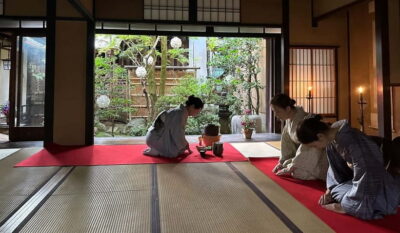
Kyoto: Kimono and Tea Ceremony Experience at Cultural Asset
Read our review →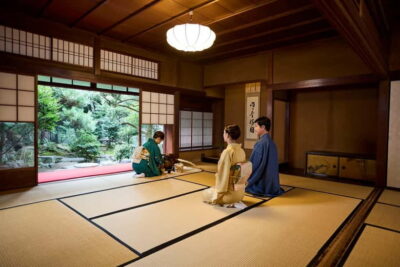
Kyoto: Kimono Tea Ceremony with Matcha and Sweet
Read our review →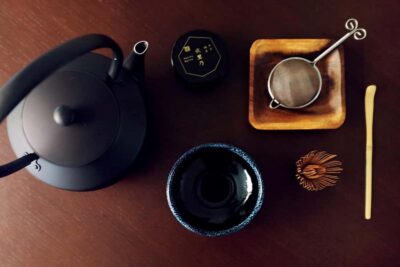
Browse the lists this tour appears in