
Review · KIMONO & TEA CEREMONY
Hiroshima: Kimono, Koto, and Simple Tea Ceremony Experience
The most memorable part of this Hiroshima experience is the setting: you enter Kazuko Mensing’s Japanese-style home, put on a kimono, and spend time with a host whose family story is tied closely to Hiroshima. I like the personal scale and the chance to try several activities, rather than sitting through a formal demonstration. I also like that you can play the koto, sip matcha, and pose with a katana or umbrella.
The main consideration is time. Ninety minutes goes quickly, especially if you want to try the koto, tea ceremony, board games, photos, origami, and calligraphy. The home requires stairs, so this is not suitable for wheelchair users, even though the experience is described as disability-friendly in other respects.
Key points to know before you book
- Kazuko Mensing leads the visit: She speaks English and Japanese and has studied the koto for 40 years.
- The home is close to Hiroshima’s key memorial area: It is about a 15-minute walk from the Atomic Bomb Dome.
- You can choose from several cultural activities: Options include koto, matcha, tea ceremony, igo, shougi, origami, and calligraphy.
- The private setting encourages conversation: You can ask questions and adjust the visit around your interests.
- Kimono photos are part of the fun: You may hold a Japanese katana or umbrella for pictures.
- Plan for stairs: The home is not wheelchair accessible.
A personal welcome in a Japanese home
Many Hiroshima activities focus on the city’s wartime past. This one gives you a quieter look at daily Japanese culture, with a host who can connect the activity to Hiroshima in a personal way.
Kazuko Mensing has lived in Hiroshima her whole life. She is also a second-generation bomb survivor, a detail that gives the visit an added human dimension. That does not turn the 90 minutes into a memorial tour, and you should not book it expecting a formal lesson on the atomic bombing. Instead, her background may give your conversation more meaning if you choose to ask about Hiroshima, family memory, or local life.
You meet outside the FamilyMart beside Toukaichi Station. Look for Kazuko wearing a short black kimono jacket. From the Atomic Bomb Dome, the meeting point is about a 15-minute walk, making it easy to pair this activity with a visit to the Peace Memorial Park and dome.
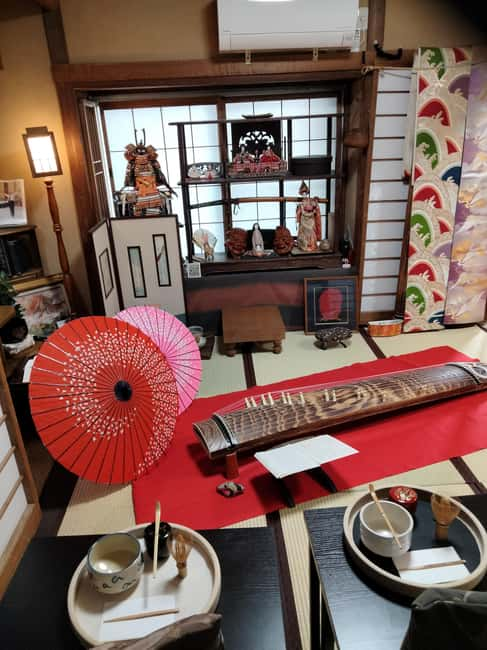
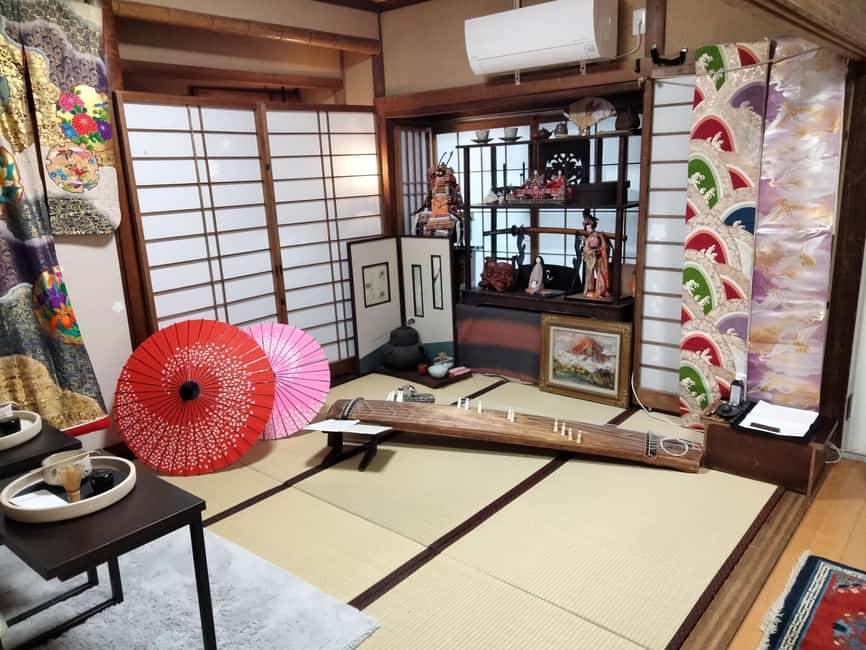
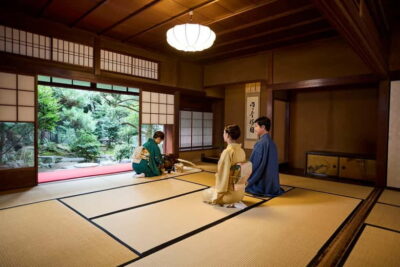
The experience takes place in a Japanese-style home decorated with cultural masks, statues, and traditional objects. That matters because the surroundings do part of the teaching. You are not simply changing clothes in a plain studio. You are spending time in a home arranged around Japanese cultural touches, with room to talk and try things at an easy pace.
More Tea Ceremonies in Japan:
- Kyoto: Tea Ceremony in a Traditional Tea House in Kiyomizu
★ 4.9 · 3,519 reviews - Kyoto: Tea Ceremony Ju-An at Jotokuji Temple
★ 4.9 · 3,207 reviews - Kyoto: 45-Minute Tea Ceremony Lesson Experience
★ 4.3 · 2,378 reviews
Choosing and wearing a kimono
The kimono dressing is the anchor of the experience. Traditional clothing can look simple in photographs, but the layers, shape, and careful arrangement make it feel quite different from putting on a costume for a quick picture.
Kimono are available for both men and women. You can expect the clothing to be selected and arranged as part of the dressing experience, rather than being handed a garment and left to work it out alone. The supplied details do not specify the full range of sizes, colors, or patterns, so if fit is important to you, ask ahead of time.
Once dressed, you can take photos with a Japanese umbrella or katana. The katana is for holding and photographs, not for sword practice. These props give you a playful way to record the visit, though the best value is not the photo alone. The clothing changes how you move, sit, and notice the ceremony around you.
I would wear comfortable clothes underneath and avoid planning this immediately before an activity that requires fast walking. The home is close to the Atomic Bomb Dome, but kimono is not ideal for rushing across town.
Children can take part as well. One nine-year-old visitor played children’s igo, tried the koto, wore kimono, drank matcha, folded paper cranes, and practiced writing Japanese characters. That makes this a useful choice for families, particularly if your child likes hands-on activities more than long museum visits.
Trying the koto with a teacher who knows the instrument
Kazuko has studied the koto for 40 years, so the instrument is more than a decorative prop. You get a chance to sit with it and try playing under her direction.
The koto is a traditional Japanese stringed instrument. For a first attempt, the pleasure comes from feeling how it works and hearing its sound, not from producing a polished performance. Expect a beginner-friendly introduction rather than a concert or a long music lesson.
This part is especially valuable because it gives you contact with a living practice. You are not only looking at an old object behind glass. You are handling the instrument and trying a few notes with someone who has spent decades learning it.
Time is the only limit. The experience includes several possible activities, and you may not have time for a full koto session plus every other option. If music is your main reason for booking, tell Kazuko early so she can give it proper attention.
Matcha and a simple tea ceremony
The tea portion introduces the meaning of Japanese tea practice without requiring you to commit to a long, formal ceremony. You can drink matcha and learn why the ceremony matters, including the care given to preparation, presentation, and the shared moment.
The word simple is important. This is not presented as an advanced tea-school performance. That makes it more approachable if you have never taken part in a tea ceremony and do not know the rules.
Pay attention to the small actions. Sitting in a traditional room, receiving the tea, and following the host’s guidance can show you how Japanese hospitality often values thoughtfulness and restraint. You do not need prior knowledge, and Kazuko’s English makes it easier to understand what you are doing and why.
Matcha can have a strong, grassy taste. If you prefer sweet drinks, do not expect it to taste like a dessert beverage. The point is the ritual and the introduction, not a café-style matcha latte.
More Kimono and Tea Ceremonies in Japan:
- Kimono Tea Ceremony at Kyoto Maikoya, NISHIKI
★ 5.0 · 911 reviews - Kimono Tea Ceremony at Tokyo, Asakusa Maikoya
★ 5.0 · 638 reviews - Kyoto: Kimono Tea Ceremony at Orizuruya Gion
★ 4.9 · 618 reviews - KYOTO Tea Ceremony with kimono near by Imamiya Jinjya Shrine
★ 5.0 · 343 reviews
Igo, shougi, origami, and calligraphy
The board games give the visit a more relaxed, social side. Igo, known in English as go, is a strategy game played with black and white stones. Shougi is Japanese chess. The activity offers both games, with children’s igo available for younger players.
You are unlikely to become an expert in 90 minutes, and that is not the point. A short game gives you an easy way to interact with Kazuko and your own group. It also breaks up the more formal parts of dressing and tea.
The child-focused igo option can be a real help for families. A nine-year-old participant was especially excited by it, which suggests that the visit can hold a child’s attention through variety. Still, the experience is not designed only for children. Adults can choose the games or skip them for more time with the koto and tea.
Origami cranes and Japanese calligraphy may also fit into the visit, depending on the time and the way you choose to spend it. Folding cranes has a particular connection to Hiroshima, and one family later left their paper cranes at the memorial associated with Sadako Sasaki. Writing Japanese characters gives you another tactile activity, but neither should be treated as guaranteed if your group chooses to focus elsewhere.
Why the private format matters
This is a private group experience, which changes the mood. You can ask questions without worrying about holding up a large class, and Kazuko can respond to the ages and interests in your group.
That flexibility is useful because the activity list is broad. One group may want to spend more time in kimono and taking photos. Another may care most about the koto and tea. A family may prefer igo, origami, and calligraphy.
The tradeoff is that a private visit can feel more like a personal appointment than a polished stage production. If you want a large-scale cultural show with several performers, this is not that. If you prefer conversation and direct help, the format works well.
The English support is another strong point. Kazuko is fluent in English, and the experience is offered in English and Japanese. You can ask about the objects in the room, the music, the tea, or Hiroshima itself without depending on gestures alone.
The cost and what you receive
At $76 per person, this is not the cheapest way to take photographs in kimono. Its value comes from the combination of dressing, instruction, cultural activities, and private time in a home.
You are paying for more than a costume change. The price includes the kimono dressing experience, koto playing, tea ceremony, katana and umbrella use, and time in a Japanese setting. You also receive direct guidance from Kazuko, whose long connection with the koto and Hiroshima adds substance to the visit.
The price makes the most sense if you take part in several elements. If you only want one quick photograph, a shorter photo-focused option may suit you better. If you want an activity that mixes clothing, music, food and drink, games, and conversation, $76 is easier to justify.
Remember that the 90-minute limit may prevent you from trying everything. I would decide on your top two or three priorities before arriving. That small bit of planning helps the visit feel full rather than rushed.
Who should book this Hiroshima activity
I would recommend it most to people who want direct contact with Japanese culture and prefer a small setting to a large tour. It suits couples, families, solo visitors, and private groups who enjoy trying things rather than only watching.
Families should consider it seriously. The kimono, games, paper cranes, and character writing offer different levels of activity for children. The host’s warm approach also matters. A child who loses interest in tea may become engaged by igo or the koto.
It is also a good choice if you have already visited the Atomic Bomb Dome and Peace Memorial Park and want to see another side of Hiroshima. The location makes it easy to add before or after the city’s major memorial sites.
You should think twice if stairs are difficult for you. The home requires going upstairs, and wheelchair users cannot take part. You should also be comfortable with a 90-minute visit that includes sitting, dressing, and moving between activities in a home setting.
The experience is LGBTQ-friendly. That clear welcome is useful for anyone who wants to know the tone before booking.
Practical timing and planning advice
The activity lasts 90 minutes, so arrive ready to begin. The meeting point is outside the FamilyMart beside Toukaichi Station, and Kazuko wears a short black kimono jacket.
Because the Atomic Bomb Dome is about a 15-minute walk away, allow enough time to leave the memorial area and find the meeting point. The information provided does not give exact starting times, so check availability when choosing your date.
I would book this earlier in your Hiroshima stay if you want local suggestions. Kazuko can offer advice about what to see and do in the city, and that kind of conversation is most useful before your schedule is already full.
Free cancellation is available up to 24 hours before the experience for a full refund. You can also reserve now and pay later, which helps if your Japan plans are still shifting.
Should you book the kimono, koto, and tea experience?
Book it if you want a friendly, personal introduction to Japanese culture near Hiroshima’s main memorial area. The strongest reasons are Kazuko’s 40 years with the koto, her fluent English, the private home setting, and the chance to choose activities that suit your group.
Do not book it expecting a full tea-school ceremony, a long music recital, or a complete lesson in every Japanese tradition. Ninety minutes is short, and the stairs rule out wheelchair users.
For most people who like hands-on cultural visits, this is a good use of part of a Hiroshima day. Set your priorities before you arrive, wear practical clothing under the kimono, and leave room for conversation. That is where this experience offers more than a quick costume photograph.
FAQ
Where does the experience meet?
Meet outside the FamilyMart right beside Toukaichi Station. Kazuko will be wearing a short black kimono jacket.
How long does the experience last?
The experience lasts 90 minutes.
How much does it cost?
The price is $76 per person.
What languages does the instructor speak?
The experience is offered in English and Japanese. Kazuko is fluent in English.
Is the experience private?
Yes. It is offered as a private group experience.
What activities are included?
The experience includes kimono dressing, koto playing, a simple tea ceremony, katana and umbrella holding for photos, and time in a Japanese-style home. Igo and shougi are also available as traditional board games.
Is the experience suitable for wheelchair users?
No. The home requires participants to go upstairs, so wheelchair users cannot take part.
How close is the experience to the Atomic Bomb Dome?
The location is about a 15-minute walk from the Atomic Bomb Dome.
Can I cancel for a refund?
Yes. You can cancel up to 24 hours in advance for a full refund.
Can I reserve now and pay later?
Yes. The activity offers a reserve-now, pay-later option.
Fresh tea listings around Japan
- Yokohama : Tea Ceremony with Sweets and Souvenir★ 5.0 · 5 reviews
- Walking Tour: Yanaka,Nezu& Sendagi: Tea Ceremony & Old Tokyo★ 5.0 · 3 reviews
- Visit local home for music and tea ceremony near Disney★ 4.9 · 13 reviews
- Yokohama: Sushi & Gyoza Cooking with Matcha & GreenTea Experience★ 5.0 · 3 reviews
- Trip to Kamakura & Enoshima: Shrines, Seaside, Temples &Tea★ 5.0 · 11 reviews
- Uji: Private immersion into Kyoto’s tea and reglious culture★ 5.0 · 17 reviews
- Kyoto tea town for matcha lovers★ 5.0 · 16 reviews
- Kyoto Matcha Green Tea Tour★ 4.5 · 23 reviews
Kimono & Tea Ceremony, compared.
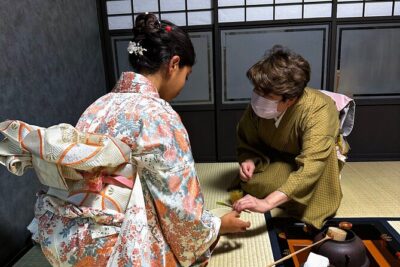
KYOTO Tea Ceremony with kimono near by Imamiya Jinjya Shrine
Read our review →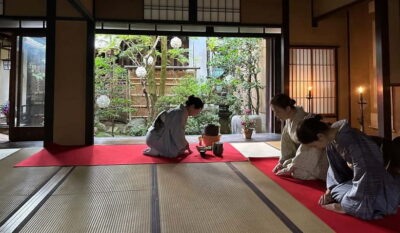
Kyoto: Kimono and Tea Ceremony Experience at Cultural Asset
Read our review →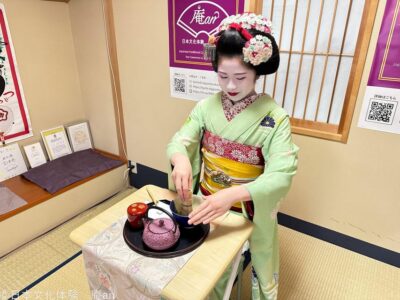
Kyoto: Kimono Tea Ceremony with Matcha and Sweet
Read our review →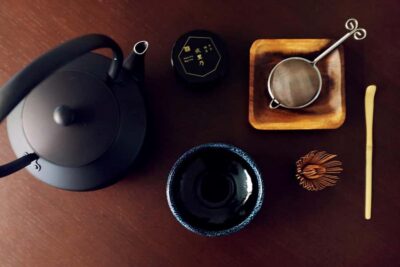
Browse the lists this tour appears in