Review · TEA CEREMONY EXPERIENCES
Kyoto Tea ceremony with Japanese Flower Arrangement Ikebana
The most memorable part of this Kyoto activity is the change of pace. You choose seasonal flowers in a flower shop, arrange them by hand, then place your work in the tokonoma, the alcove of a traditional Japanese room. The setting is a roughly 100-year-old townhouse near Kinkaku-ji and Daitoku-ji, not a large performance hall.
I like the personal scale, with no more than six people, and the way ikebana leads naturally into the tea ceremony. I also like that your arrangement is not simply packed away at the end. It becomes part of the room, and you may take it to your hotel. The main consideration is timing: at about 90 minutes, this is an introduction rather than a full study of either art.
Key points to know
- Choose your own seasonal flowers at the flower shop before you begin arranging them.
- Make an ikebana arrangement from scratch, with guidance suited to beginners.
- Display your work in a tokonoma during the tea ceremony.
- Watch and take part in tea preparation, with a chance to play the role of tea master.
- Enjoy a group of no more than six, useful if you want a quieter, more personal class.
- Take your flowers with you afterward, adding a practical souvenir to the cultural lesson.
A 90-minute meeting of flowers and tea
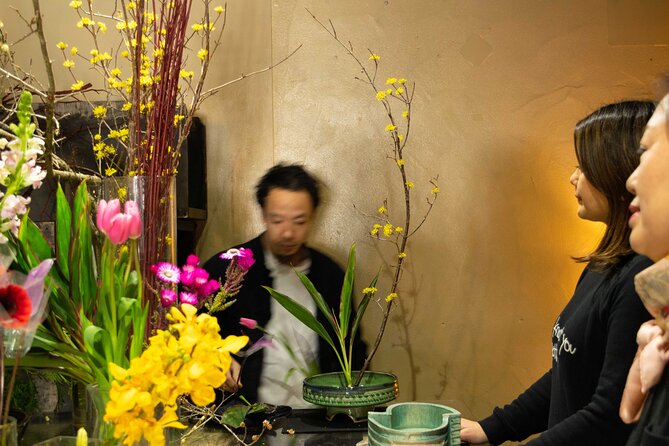
This activity brings together two traditional Japanese arts that are often taught separately. First comes ikebana, the careful arrangement of flowers and branches. Then comes tea ceremony, with your finished arrangement placed in the room as part of the setting.
That order matters. You do not simply watch a tea ceremony from the sidelines. You first make something with your hands, then see how it belongs in a traditional room. The result gives you a better sense of how Japanese arts can connect nature, space, movement, and attention.
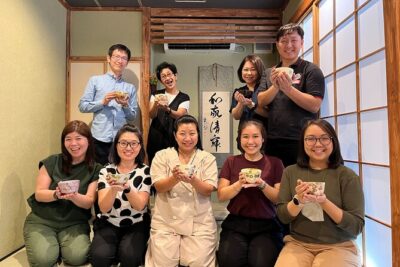
The class takes place at a flower shop in a renovated townhouse about 100 years old. That setting gives the session a domestic, family-like feel rather than the polish of a large tourist venue. The small group limit of six supports this mood and gives the instructor room to help each person.
You should expect a gentle pace. This is not a rushed checklist of Japanese customs. The stated purpose is to pause, observe the natural form of the plants, and think about how your choices express your own past and present. Some people will find that reflective side appealing. Others may prefer a more energetic activity with more sightseeing built in.
More Tea and Calligraphy Workshops in Japan
- Kyoto: Tea Ceremony Meditation – Make Matcha with Tea Master
★ 4.8 · 406 reviews - Kyoto Hidden Riverside Zen Mediation and Uji Matcha Experience
★ 5.0 · 9 reviews - Whisk Your Own Matcha: A Zen Matcha Experience at Temple
★ 3.6 · 7 reviews
Choosing flowers near Kinkaku-ji and Daitoku-ji
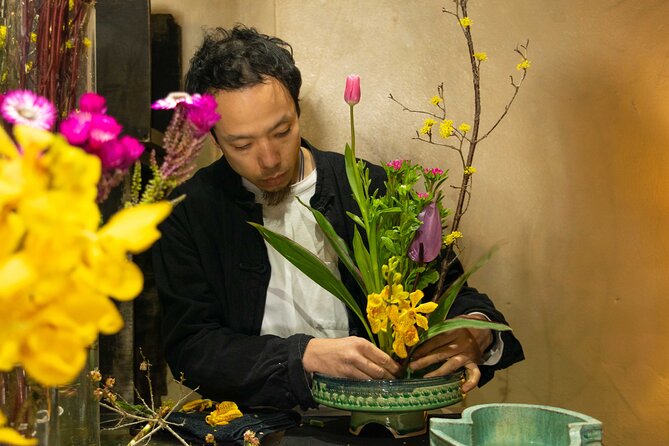
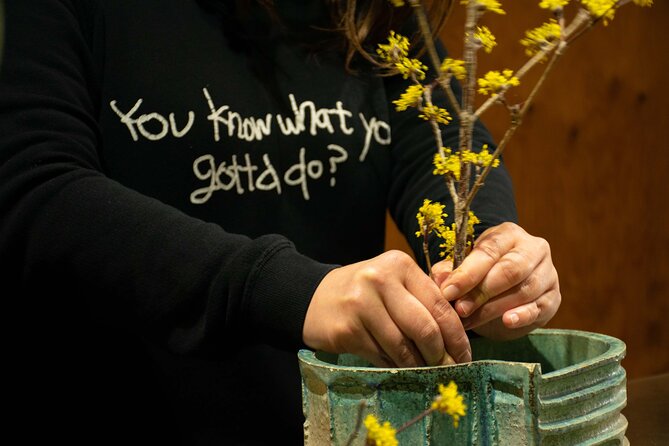
You begin by selecting flowers from the shop. The choices follow the season, so the arrangement can change depending on the time of year. That seasonal element is central to Japanese flower art. You are not working from a fixed plastic display or a single standard design.
The selection process also gives you a useful starting point if you know little about flowers. You do not need to arrive with a design in mind. Instead, you can respond to the shapes, colors, and natural lines in front of you, with the instructors guiding you as you go.
The location near Kinkaku-ji and Daitoku-ji makes this a practical addition to a northern Kyoto sightseeing day. You can pair it with temple visits in the same general part of town, though the activity itself ends back at the meeting point. The information provided does not give a walking time from either temple, so plan your route with care rather than assuming the shop is directly beside the gates.
A mobile ticket makes entry simple, but confirmation is subject to availability and may arrive within 48 hours of booking. I would avoid booking this at the last minute if your Kyoto schedule is tightly packed.
Making an ikebana arrangement as a beginner
The workshop is designed for beginners. You will learn about the art and history of ikebana while creating your own arrangement, rather than sitting through a lecture before handling the flowers.
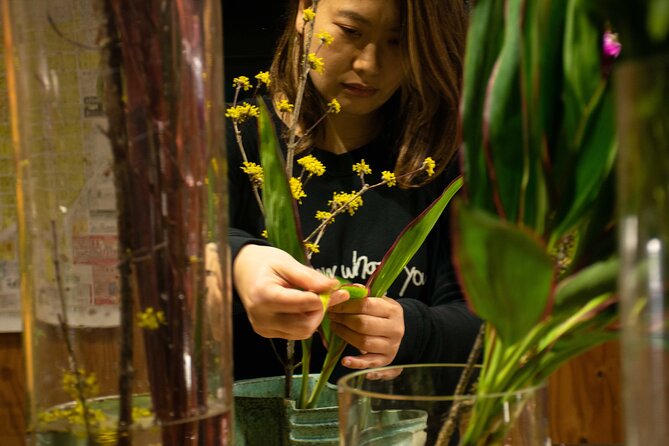
The instructor’s approach differs slightly from strict classic forms. The focus is on bringing out the beauty of each plant while respecting its natural shape. This gives you room to work with crooked stems, open spaces, unusual angles, and the less-than-perfect forms that occur in real plants.
That approach reflects wabi-sabi, the appreciation of simplicity, age, irregularity, and imperfection. You are not being asked to force every branch into a neat symmetrical pattern. The point is to notice what the flower already offers and make thoughtful choices around it.
I like this method for first-time participants because it removes some pressure. You do not need to produce a museum piece. You need to pay attention, make decisions, and learn how spacing and direction affect the whole arrangement.
The workshop is also described as a form of meditation and self-dialogue. That may sound lofty, but the practical meaning is clear: you slow down and focus on one small task. If you have spent the day moving between Kyoto’s temples, trains, and crowded streets, this quiet concentration can be a welcome change.
Still, keep your expectations sensible. A 90-minute course cannot cover every school, rule, tool, or historical period in ikebana. You will get a hands-on introduction and a personal arrangement, not professional-level training.
Placing your work in the tokonoma
After you finish the flowers, you move into a traditional Japanese room for the tea ceremony. Your arrangement is displayed in the tokonoma, the recessed alcove traditionally used for art, calligraphy, and seasonal decoration.
This is one of the best details in the activity. Your work is not treated as a disposable classroom exercise. You see it in the kind of space where ikebana has a clear cultural purpose. The arrangement helps prepare the room for the tea ceremony and links your creative choices to the season.
The setting also lets you notice a basic principle of Japanese interiors: a small number of carefully chosen objects can carry a lot of meaning. The alcove does not need to be crowded. The flowers, the room, and the ceremony work together.
You may take your floral creation back to your hotel afterward. That makes the activity more useful than a cultural demonstration that leaves you with only a photograph. You will need to handle the flowers carefully, and the information provided does not specify packaging or transport arrangements, so ask the instructor how best to carry them before you leave.
More Tea and Calligraphy Workshops in Kyoto
- Kyoto: Nighttime Zen Meditation and Matcha Tea Experience
★ 5.0 · 7 reviews - Kyoto: Make Zen Garden and Taste Matcha in Pottery Shop
★ 5.0 · 5 reviews - Tea ceremony at Kyoto’s Zen Temple Teahouse
★ 5.0 · 2 reviews - Silent Beauty of Kyoto Zen Walk and Tea Experience
★ 5.0 · 2 reviews
Watching the tea ceremony, then taking part
In the tea room, you will see how a tea master conducts the ceremony. You also have the chance to play the role of tea master yourself. That second part is important because it turns the activity from a show into a lesson in movement and etiquette.
You may notice that the ceremony gives as much weight to preparation and gesture as to the tea itself. The arrangement in the alcove, the way the room is used, and the deliberate actions all belong to the same cultural setting.
The activity information does not list every step of the tea ceremony or specify the type of tea served. I would therefore treat this as a guided introduction, not a formal ceremony with every traditional element guaranteed.
The instructors are described as patient, informative, and kind. That matters here. Tea ceremony can feel intimidating if you worry about making a mistake. A small class and supportive instruction should make it easier to ask questions and try the movements without feeling watched by a large audience.
The tea portion also gives you a chance to connect the two arts. Ikebana asks you to work with natural forms. Tea ceremony asks you to work with space, objects, timing, and hospitality. Both reward attention to small details.
What the small group changes
With a maximum of six participants, this is much more intimate than a group demonstration. You should have a better chance to receive direct help with your flowers and to ask about the meaning behind the practices.
A small group can also suit solo visitors particularly well. The family-like atmosphere described for the class may make it easier to join alone without feeling as if you are entering a formal school or private club.
The tradeoff is that a small class may have less anonymity. You will be part of the room, not simply watching from the back. If you prefer to keep a low profile, the active tea portion may feel more personal than expected.
The activity is suitable for most people, and service animals are allowed. It is near public transportation, though the supplied information does not name a particular station, bus route, or walking distance. Check your route before setting out, especially if you are coming from central Kyoto.
Is $61 a fair price?
At $61, the value depends on what you want from a Kyoto cultural activity. You are paying for about 90 minutes, instruction in two traditional arts, flowers selected for your arrangement, a small group, and a setting in a renovated traditional townhouse.
That is a fair price if you value direct participation. You are not only observing a ceremony. You create something, place it in the room, and have an opportunity to perform part of the tea ritual yourself.
The value is less clear if your priority is maximum sightseeing time. The session does not include temple admission, transportation, or a longer guided visit around Kinkaku-ji or Daitoku-ji. It works best as an added activity near a temple day, not as a substitute for seeing Kyoto’s major sights.
Your own arrangement also gives the price a practical benefit. You can bring the flowers back to your hotel, though you should confirm how they will be wrapped and carried. That personal result is more meaningful than a standard souvenir for many people.
Who will enjoy this most?
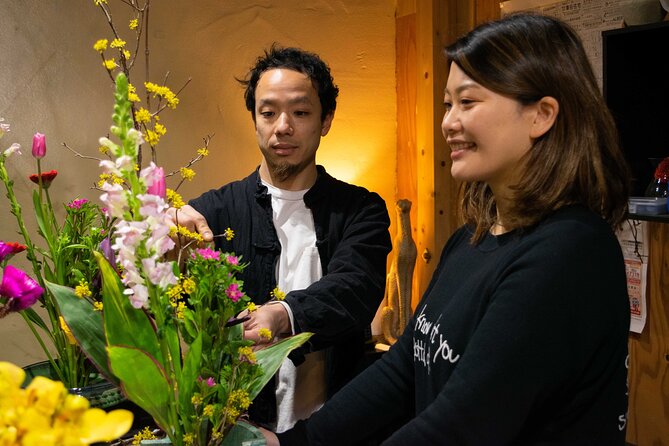
I would recommend this for you if you want a calm, hands-on introduction to Japanese culture. It suits first-time ikebana students, solo visitors, couples, and small groups who prefer conversation and personal attention over a large staged presentation.
It is also a good choice for people interested in quiet activities. The organizers present ikebana as a way to reflect and reconnect with nature. If that sounds appealing, the class may become one of the more peaceful parts of your Kyoto schedule.
Families can consider it too, though the supplied information does not give a minimum age or specific child arrangements. Ask before booking if you are traveling with young children.
You may want to skip it if you want a fast, highly structured introduction with many historical facts, or if you are looking for a full-day art course. The experience is short and personal. Its strength is the chance to slow down and make something, not the amount of material covered.
Practical details before you book
The meeting point is 44-4 Murasakino Kamimonzencho, Kita Ward, Kyoto, 603-8217, Japan. The activity ends at the same place.
Your booking confirmation is sent within 48 hours, subject to availability. Since the group is limited to six, I would book before building the rest of your day around it. Use the mobile ticket at the meeting point.
Free cancellation is available if you cancel at least 24 hours before the local start time. Cancellations made within 24 hours are not refunded, and changes inside that window are not accepted.
The activity has a rating of 5 from three submitted ratings. That is an encouraging signal, but the sample is small. I would place more weight on the clear description of the format: a personal class, patient instruction, seasonal flowers, and a family-style setting.
Should you book this Kyoto tea and ikebana class?
Book it if you want to do more than look at Japanese traditions from a distance. You will choose flowers, make an arrangement, place it in a tokonoma, and take part in a tea ceremony in a small townhouse setting.
I especially recommend it for a solo visitor or anyone seeking a quiet break from Kyoto’s busiest sights. The main limits are the short duration and the lack of detailed information about the exact tea steps and transport from nearby landmarks.
For $61, this is a solid choice for hands-on cultural time near Kinkaku-ji and Daitoku-ji. Go in expecting an introduction, not mastery, and you are likely to get a thoughtful, personal memory that can continue in your hotel room with the flowers you made.
FAQ
Where does the ikebana and tea ceremony activity take place?
It takes place at 44-4 Murasakino Kamimonzencho, Kita Ward, Kyoto, 603-8217, Japan, in a flower shop located in a renovated traditional townhouse.
How long does the activity last?
The activity lasts approximately 1 hour and 30 minutes.
What happens first during the activity?
You begin by selecting seasonal flowers from the flower shop, then create your own ikebana arrangement with guidance from the instructors.
What happens after the ikebana workshop?
You move to a traditional Japanese room, where your arrangement is displayed in the tokonoma before the tea ceremony begins.
Can I take part in the tea ceremony?
Yes. You can watch the tea master and have the opportunity to play the role of tea master yourself.
Can I take my flower arrangement with me?
Yes. If you wish, you may take your floral creation back to your hotel.
How many people can join the activity?
The group has a maximum of six participants.
What is the cancellation policy?
You can cancel for a full refund up to 24 hours before the local start time. Cancellations or changes made less than 24 hours before the start time are not accepted and are not refunded.
More Tea Ceremonies in Kyoto
- Kyoto: Tea Ceremony in a Traditional Tea House in Kiyomizu
★ 4.9 · 3,519 reviews - Kyoto: Tea Ceremony Ju-An at Jotokuji Temple
★ 4.9 · 3,207 reviews - Kyoto: 45-Minute Tea Ceremony Lesson Experience
★ 4.3 · 2,378 reviews - Kyoto: Table-Style Tea Ceremony at a Kyo-Machiya
★ 4.9 · 1,211 reviews
Fresh tea listings around Kyoto
- Kyoto: Authentic Tea Ceremony in a Small Group★ 5.0 · 7 reviews
- Uji Walking Tour – Byodo-in temple and Tea Ceremony from Kyoto★ 3.5 · 3 reviews
- Traditional Tea Ceremony in Kyoto★ 4.5 · 3 reviews
- Tea Ceremony Experience in Traditional Kyoto Townhouse★ 5.0 · 19 reviews
- Tea Ceremony in 150 Years Old Townhouse with Tables and Chairs★ 5.0 · 22 reviews
- Tea ceremony at Kyoto’s Zen Temple Teahouse★ 5.0 · 2 reviews
- Sencha-do the Japanese Tea Ceremony Workshop in Kyoto★ 5.0 · 21 reviews
- Silent Beauty of Kyoto Zen Walk and Tea Experience★ 5.0 · 2 reviews
Tea Ceremony Experiences, compared.
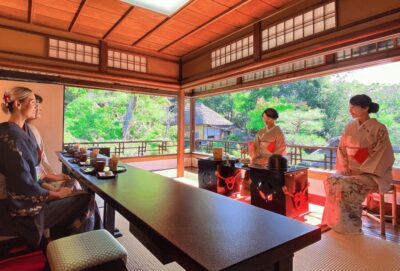
Kyoto: Tea Ceremony in a Traditional Tea House in Kiyomizu
Read our review →
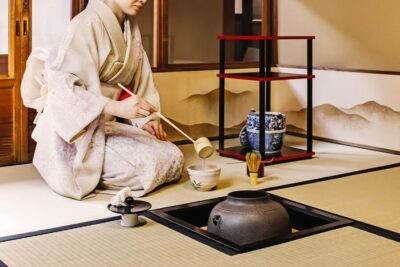
Kyoto: 45-Minute Tea Ceremony Lesson Experience
Read our review →
Kyoto: Table-Style Tea Ceremony at a Kyo-Machiya
Read our review →