
Review · TEA TASTINGS
Xi’an Noodle Making and Tea Tasting Experience
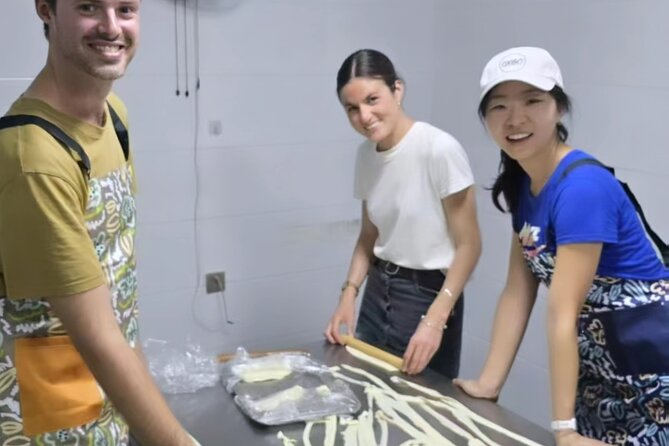
Xi’an’s famous Biangbiang noodles are the main event here, and you get to make them from scratch in a private courtyard setting. Under the guidance of local hosts Jeffrey and Cristiano, you’ll stretch the dough, learn the story behind the famously difficult Biang character, and sit down to eat what you made.
I like the mix of hands-on cooking and local conversation, rather than a meal that simply arrives at the table. I also like the slower cultural touches: tea tasting, calligraphy, optional Mahjong, and traditional music. The main consideration is the meeting point, which can be hard to identify on Chang An Xi Lu, so use the WhatsApp contact and arrange to meet Jeffrey on the street.
Key points to know before booking
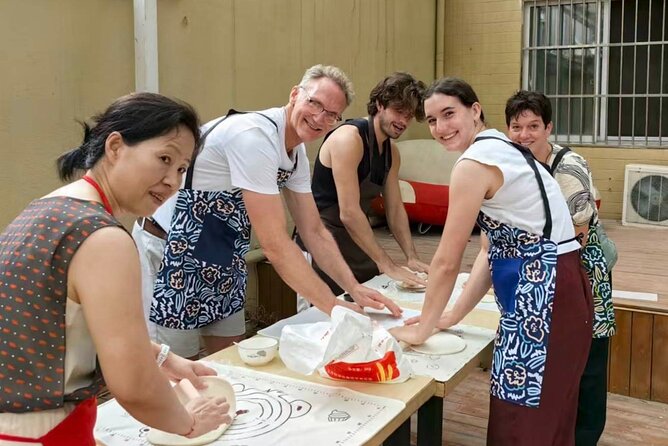
- Make Biangbiang noodles from scratch: Learn to shape Xi’an’s thick, chewy noodles before eating your own work.
- Practice the 56-stroke Biang character: Calligraphy gives the noodle lesson a distinctly local twist.
- Share tea and conversation: The hosts use tea time to talk about daily life in Xi’an.
- Try Mahjong if you want: The game is optional, so you can watch, play, or simply continue chatting.
- Finish with a full meal: Your noodles are served with regional dishes and traditional music.
- Private four-hour format: Only your own group participates, with mobile tickets and free cancellation up to 24 hours before the start.
Why Biangbiang noodles make a good Xi’an lesson
Food is one of the easiest ways to understand Xi’an, and Biangbiang noodles give you something to do with your hands as well as something to eat. These broad, chewy noodles are closely associated with Shaanxi cuisine, the food tradition of the region around Xi’an. Their name is often written with a famously complex Chinese character, usually described here as having 56 strokes.
That unusual character is not a minor side note. It helps explain why this dish has such a strong local identity. You are not just learning a recipe, you are handling a food with a name that has become a small cultural puzzle.
I like this format because the cooking has a clear payoff. You work with the dough, take part in shaping the noodles, and then eat the result at the same place. You do not need to wonder how much of the meal was prepared in advance. The point is participation.
The cooking lesson is also well suited to families and small groups. Children can take part in the physical work, while adults may enjoy the talk around the food and the calligraphy. The private format means you are not being folded into a large class with strangers, though the exact pace can still depend on your group.
More Tea Tastings in China
- Tea Tasting and Pairing Concept Workshop
★ 5.0 · 57 reviews - Biking Real Shanghai& Tea Tasting Experience
★ 4.5 · 45 reviews - Shanghai 3-Hour Afternoon Tea Tasting and Dessert Tour
★ 4.9 · 15 reviews
Finding the courtyard on Chang An Xi Lu
The listed starting point is Tiedan Chicken Soup Sliced Noodles at 5WRR+C4M, Chang An Xi Lu, in Yan Ta District. The activity ends at the same meeting point, which keeps the afternoon simple once you arrive.
The practical challenge is getting there. A street address and a plus code may not be as easy to use in Xi’an as a familiar hotel lobby or major landmark. The narrow street access mentioned by the host makes the final approach worth planning carefully.
Jeffrey contacted one family through WhatsApp the day before and arranged to meet them on the street, then walk them to the location. I would use that option whenever possible. Confirm the meeting details before the activity, keep your phone charged, and allow extra time for the final few minutes.
This is not a sightseeing tour with several city stops. You are going to one place for a workshop, so arriving late can cut into the cooking and meal time. Public transportation is nearby, but no specific station or route is provided. Check your route in advance rather than assuming the meeting point will be obvious.
Tea first, with time to settle in
Tea is part of the welcome and continues through the social side of the experience. You can expect fragrant Chinese teas and an informal chance to talk with the hosts about local life in Xi’an.
That pause matters. A noodle lesson can feel rushed if everyone walks in, handles dough, and immediately sits down to eat. Tea gives the session a gentler opening and lets you get comfortable with Jeffrey and Cristiano before the practical work begins.
I also like that tea is treated as a social habit, not just a tasting flight. The supplied details do not identify the exact teas or explain a formal tasting sequence, so do not book this expecting a technical tea class. Think of it as a relaxed introduction to tea culture, conversation, and the household rhythm of the workshop.
For you, the value is in the exchange. You can ask about everyday life in Xi’an while doing something easy and familiar, such as drinking tea. That makes the experience more personal than a standard restaurant meal, even though the food remains the main focus.
Making the dough and stretching the noodles
The cooking lesson centers on Biangbiang noodles made from scratch. You will learn the process with a local chef, then work toward the wide, chewy noodles that define the dish.
The information provided does not specify every cooking step or how much individual instruction each person receives. Still, the structure is clear: this is a practical workshop, not a demonstration where you only watch someone else prepare lunch.
Expect the best part to be the hands-on handling of the dough. Noodle making has a useful balance of skill and play. You can follow the chef’s method, but the finished shape may not look perfect. That is part of the fun, especially in a private group where you do not have to keep pace with a room full of other participants.
I would wear comfortable clothing and avoid scheduling a major activity immediately afterward. The session lasts about four hours, and the cooking, cultural activities, meal, and conversation are meant to fill a substantial half-day. The supplied details do not state whether aprons or other protective clothing are provided, so dress with ordinary food preparation in mind.
The meal afterward gives the lesson purpose. You are not making noodles as a craft exercise and then moving on to something unrelated. You eat your handmade noodles along with regional dishes, which lets you compare your work with the flavors and presentation of the finished meal.
Same city, a very different cup:
- One-Day Hangzhou Dragon Well Tea Culture & West Lake Private Tour
★ 5.0 · 98 reviews - Traditional Chinese Tea Ceremony Experience
★ 4.7 · 74 reviews - Beijing Culture: Tea Ceremony, Heritage Instrument & Calligraphy
★ 5.0 · 57 reviews - Tea Village in lost Town and Buddha 1 day tour
★ 5.0 · 32 reviews
The 56-stroke character and a little calligraphy
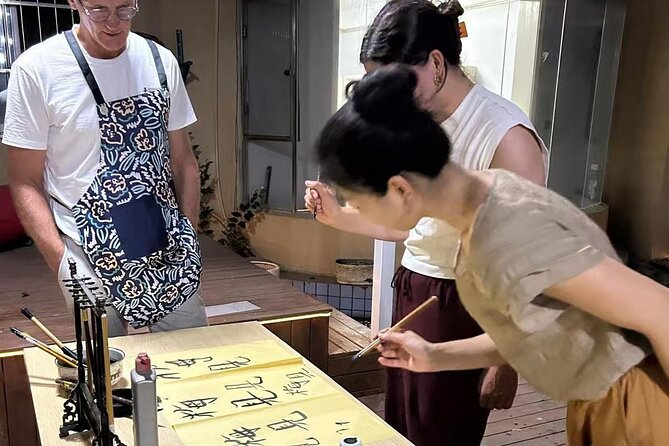
The calligraphy segment focuses on the character for Biang, one of the most memorable details of the experience. At 56 strokes, it is far more complicated than the basic Chinese characters usually introduced to beginners.
You do not need to arrive with calligraphy experience. The appeal is trying to write a character that even many visitors will find visually bewildering. It connects the name of the food to the written language and gives you a souvenir of the afternoon in your own memory, even if the paper does not belong in a museum.
This portion also breaks up the cooking. After working with dough, you shift to brush, ink, and careful movement. That change of pace can be welcome during a four-hour program.
The available details do not say whether you take home a finished piece, so do not count on a formal calligraphy keepsake. The value is in learning the character and seeing how food, language, and local identity meet in one small activity.
Mahjong is optional, and that is a good choice

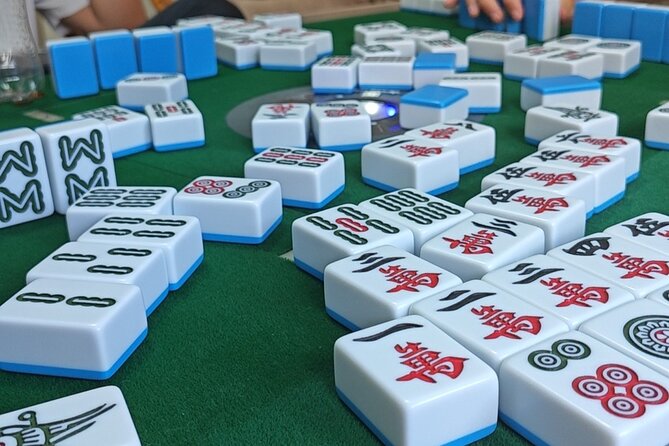
Mahjong is included as an optional activity. You can try your hand at the game, watch the hosts play, or skip it and continue with tea and conversation.
That flexibility is useful because Mahjong can take a while to understand. If you have played before, you may enjoy the chance to sit down with a local group. If you have never seen the game, you can treat it as a cultural window rather than another skill you must master.
The details do not specify the rules, language of instruction, or length of the Mahjong session. I would not book this experience mainly for Mahjong. See it as an extra social activity that can make the afternoon feel more like time spent in a local home or courtyard than a tightly timed cooking class.
For families, the optional setup helps. Not everyone needs to participate in every part. One person can write calligraphy, another can try Mahjong, and someone else can remain with the tea while the cooking continues.
A regional meal with music at the end
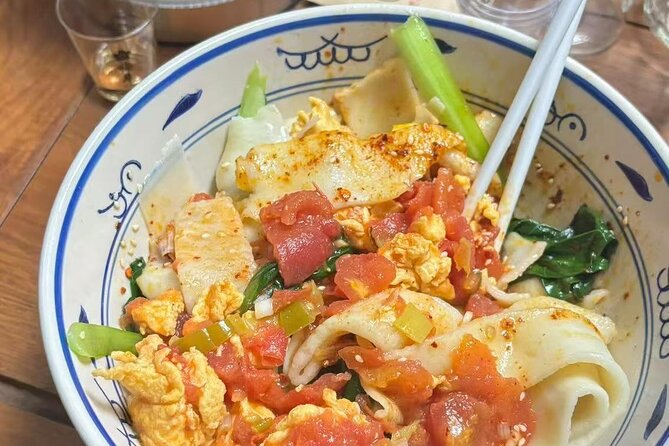
The final meal includes the Biangbiang noodles you made, other regional dishes, and traditional music. That ending gives the afternoon a clear shape: learn, make, share, then eat.
The meal is more substantial than a quick taste of noodles. The exact dishes are not listed, so you should not expect a fixed menu description before booking. What you can count on is handmade noodles plus regional food, served as the closing part of the activity.
Traditional music adds atmosphere, but it does not turn the workshop into a stage show. The strongest part of the experience remains the chance to sit with your hosts and eat food connected to the lesson. The music is a pleasant cultural layer rather than the reason to choose this activity.
I especially like the connection between effort and appetite. Once you have worked with the dough and attempted the character, the meal has a story behind it. That is a better memory than simply ordering a bowl of noodles in a restaurant, even if a restaurant may offer more choice and a quicker meal.
What the $69.90 price includes in practical terms
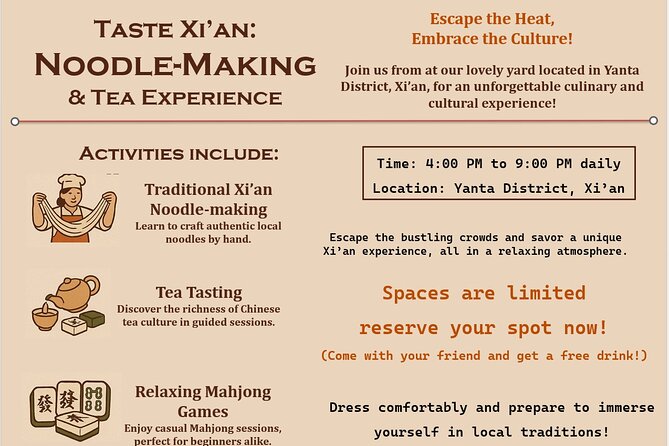
At $69.90 per person, this is not the cheapest way to eat noodles in Xi’an. You can find a bowl of local noodles for far less. The price makes more sense if you want a four-hour private activity that combines food, instruction, tea, calligraphy, Mahjong, conversation, and a meal.
The private format is important. Only your own group participates, so the experience can be more comfortable for families, couples, or friends who want to ask questions without holding up a larger class. It also means the cost is paying for time and personal attention, not only ingredients.
Group discounts may improve the value for a larger party. Since the exact discount is not stated, check the total before you commit. A group of friends may find the price easier to justify than a solo participant, particularly if everyone plans to take part in the cooking and meal.
I would compare this with what you want from Xi’an. If your priority is the lowest-cost lunch, choose a noodle shop. If you want an activity that helps you understand one local dish and gives you a social afternoon, the price is more reasonable.
The average booking lead time is 41 days. That suggests you should reserve early if your Xi’an dates are fixed, especially if you want a particular day. The activity has a five-star rating from six submitted ratings, which is a small sample, so I would read that as encouraging rather than proof that every session will be identical.
Who should book this Xi’an workshop
I would recommend it most strongly to:
- Families who want a shared activity with food at the end.
- Couples looking for a private cultural experience rather than a standard restaurant visit.
- Small groups interested in cooking and conversation.
- First-time visitors who want a manageable introduction to Shaanxi food.
- Anyone curious about Chinese calligraphy but not ready for a formal class.
The experience may be less suitable if you want a fast meal, a full sightseeing itinerary, or a detailed culinary course with a printed recipe and precise lesson plan. The provided information does not promise recipe handouts, transport, or a formal cooking certificate.
It is also worth thinking about the four-hour duration. Tea, calligraphy, Mahjong, cooking, eating, music, and conversation create a full half-day. That is an advantage if you enjoy a relaxed pace, but it may feel long if you only want to sample Biangbiang noodles.
Service animals are allowed, and the meeting point is near public transportation. The activity is private, but the information does not describe full accessibility details for the courtyard, seating, or cooking area. If you have mobility needs, ask the provider before booking.
Booking, meeting, and cancellation advice
Confirmation is provided at booking, and mobile tickets are available. Since the meeting point may be difficult to spot, contact the provider before the day of the activity and use the street-meeting arrangement if offered.
The experience requires a minimum number of participants. If that minimum is not reached and the provider cancels, you will be offered another date or experience, or receive a full refund.
You can cancel for a full refund up to 24 hours before the local start time. Cancellations or changes made inside that 24-hour window are not refunded or accepted, so keep your Xi’an schedule reasonably firm once the deadline passes.
Should you book the Biangbiang noodle experience?
Book it if you want to spend a half-day making food, learning a playful piece of Chinese writing, and talking with local hosts. The strongest features are the hands-on noodles, the private setting, and the way tea, calligraphy, Mahjong, and music turn a meal into a broader cultural visit.
I would be more cautious if your schedule is tight or if you mainly want inexpensive food. Allow time to find the starting point, confirm the street meeting details with Jeffrey or the provider, and think of the $69.90 as the cost of a four-hour private experience, not a bowl of noodles.
For families and small groups, this is an easy choice to consider. For solo visitors, the price may feel higher, but the private format can still be worthwhile if personal instruction and local conversation matter more to you than keeping lunch cheap.
FAQ
How long does the Xi’an noodle and tea experience last?
The activity lasts approximately four hours.
Where does the experience start?
It starts at Tiedan Chicken Soup Sliced Noodles, 5WRR+C4M, Chang An Xi Lu, Yan Ta District, Xi’an, Shaanxi, China, 710063.
Where does the activity end?
The experience ends back at the starting meeting point.
Is this a private activity?
Yes. Only your group participates.
What activities are included?
You can make Biangbiang noodles, practice calligraphy with the 56-stroke Biang character, taste Chinese tea, and try Mahjong. Mahjong is optional.
What happens at the end of the workshop?
You eat the handmade noodles along with regional dishes, accompanied by traditional music.
Can I cancel for a full refund?
Yes. You must cancel at least 24 hours before the local start time for a full refund. Changes or cancellations made less than 24 hours before the start are not accepted or refunded.
More Food and Drink Tours in China
- Private Shanghai City and Zhujiajiao Combo Tour with Boating, Tea Tasting, Lunch
★ 5.0 · 15 reviews - Tea Tasting & Brewing Experience
★ 5.0 · 10 reviews - Xi’an Chinese Calligraphy Workshop: Ink Art & Tea Tasting
★ 5.0 · 4 reviews - Jakarta: Volcano, Tea/Rice Fields, Hot Spring, Local Food
★ 4.9 · 515 reviews
Fresh tea listings around China
- Xi’an Chinese Calligraphy Workshop: Ink Art & Tea Tasting★ 5.0 · 4 reviews
- Qixianfeng Tea Plantation Tour in Yangshuo★ 4.6 · 4 reviews
- 3 hours Xi’an Mahjong Class with Local Tea★ 5.0 · 2 reviews
- Xi’an Calligraphy & Tea Ceremony – Dive into Ink & Brush Artistry★ 5.0 · 4 reviews
- Half-day Tour: Largest Tea Plantation & Amazing Xianggong Hill★ 5.0 · 9 reviews
- Experience Chengdu: Private Tea-Making Day Tour of Mengdingshan Tea Plantation★ 4.5 · 7 reviews
- 1-day Village Tea Picking, Roasting & Serving Guided Private Tour from Hangzhou★ 5.0 · 9 reviews
- Shanghai 3-Hour Afternoon Tea Tasting and Dessert Tour★ 4.9 · 15 reviews
Tea Tastings, compared.
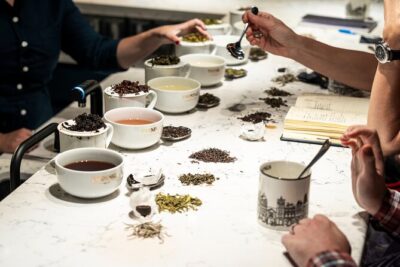
Twinings 2-Hour Tea Tasting Masterclass in London
Read our review →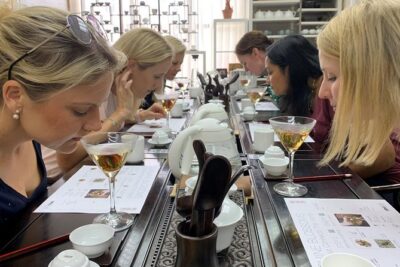
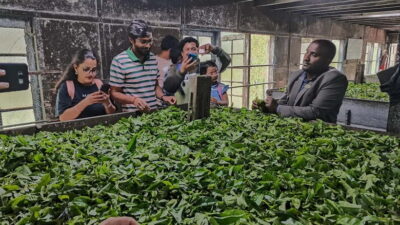
Munnar: Tea trail, Tea Factory, and Tea Tasting Tour
Read our review →
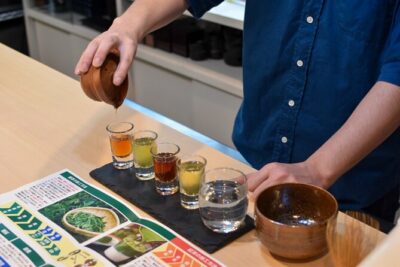
Matcha Experience with of Japanese Tea Tasting in Tokyo
Read our review →
Nara:5 Type of Tea Tasting & Mindful Tea Ceremony
Read our review →
Montmartre Hill French Afternoon Tea Tasting Tour with Crepes and Macarons
Read our review →
Munnar Tea Trail Tour , Tea factory visit & Tea Tasting
Read our review →Browse the lists this tour appears in